Thursday, August 4, 2016

Tuesday, August 2, 2016
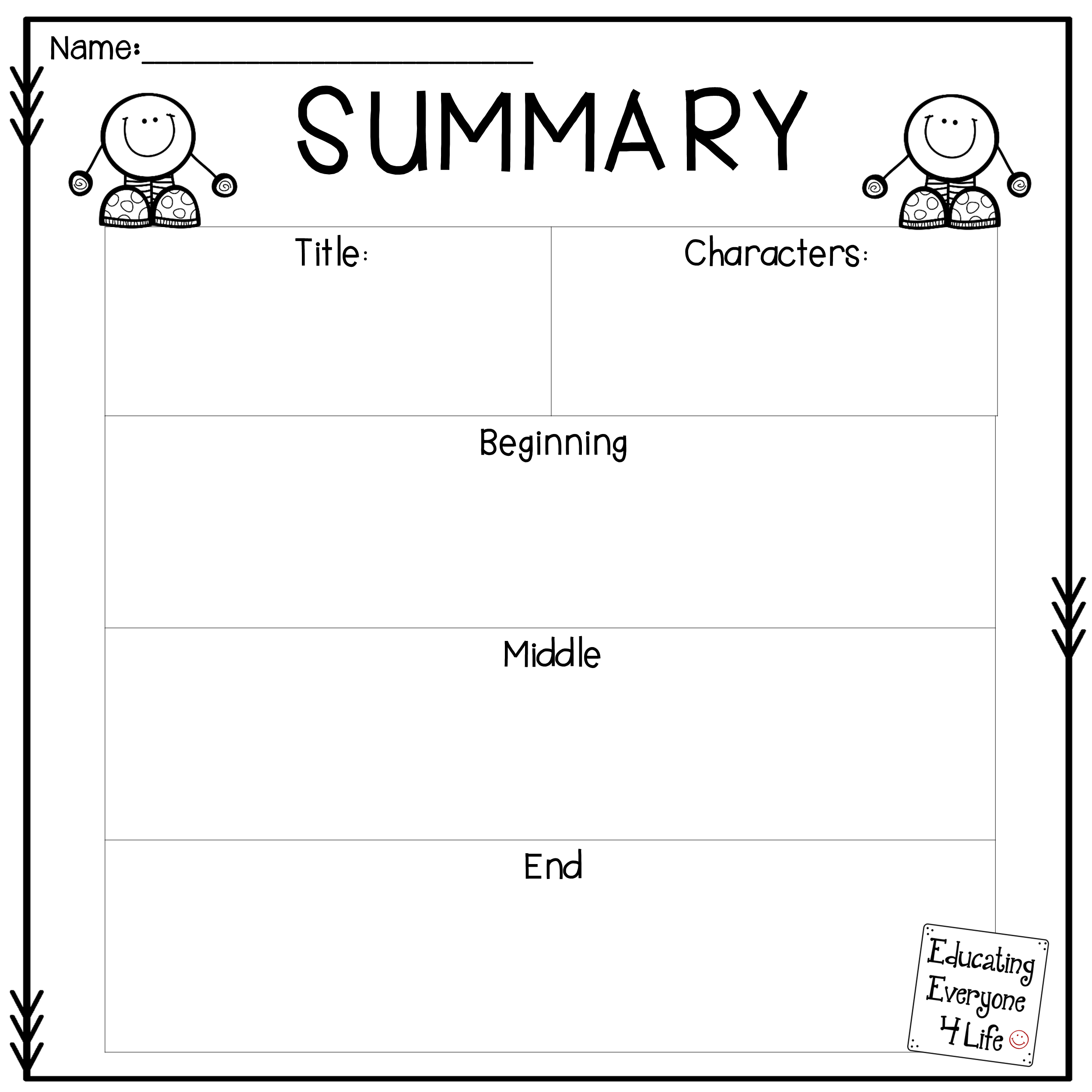
Develop Literacy Skills With Reading Write-Ups
Are you looking for reading activities to help your students develop their reading comprehension skills? Reading Write-Ups are a great way to help students develop and improve their literacy skills!
Click Here To Download These Reading Write - Ups

I love to laminate the pages in this resource, and I let my students use dry erase markers during their reading time and during our literacy station rotations.
Visit Me At: Educating Everyone For More Ideas and Freebies!

Sunday, June 5, 2016
Accommodations vs. Modifications In The Special Education Classroom
What's the difference between
accommodations and modifications?

CLICK HERE FOR THIS
 |
| Click Here To Download |
Monday, February 1, 2016
Communicating In The Classroom
The world is becoming more multilingual and miscommunication can be avoided if we begin to break down the language barriers.
Communication is the key to success in the classroom. For most children, communicating with their families, classmates, and teachers is an easy process. However, communication may be difficult and challenging for children who are learning a new language or for children who have learning disabilities.

Communication is the key to success in the classroom. For most children, communicating with their families, classmates, and teachers is an easy process. However, communication may be difficult and challenging for children who are learning a new language or for children who have learning disabilities.
Reasons Children And Adults Need To Communicate.
- To learn
- To satisfy a need
- To express thoughts and attitudes
- To form relationships
- To develop social skills
Through my experience as an ESL teacher, and a special education teacher I have learned through trial and error several effective strategies to use with students who need extra support understanding verbal and non-verbal communication.
Cultural Awareness
Teachers must understand Cultural Awareness and learn about different cultures. Encourage all cultures to share and celebrate their similarities and differences.
As a classroom teacher communicating with families who speak a different language can be a challenge. It is important to help multicultural families unite and work together. When teachers and the community work together children are more successful in the classroom.
Children need academic content in both their native language and the language they are learning.
As a classroom teacher, I know that it can be frustrating to try to communicate with a parent who does not speak your language.
As a classroom teacher communicating with families who speak a different language can be a challenge. It is important to help multicultural families unite and work together. When teachers and the community work together children are more successful in the classroom.
Children need academic content in both their native language and the language they are learning.
As a classroom teacher, I know that it can be frustrating to try to communicate with a parent who does not speak your language.
Empathize and Keep A Close Eye On Unspoken cues from the student.
Teachers can assign a buddy or another students who speaks the same language as the second language learner to help the student transition and feel safe.
Use Visual and Pictorial Representations
Using pictures to teach can help children understand what the teacher is communicating. Teachers can use pictures for social situations and academic skills.
When teaching students vocabulary words I allow them to view pictures of the term. Giving students the opportunity to illustrate the word will also help them make a meaningful connection. I modify my instruction to meet the needs of the learner.
For the general education student, I may use the following lesson:
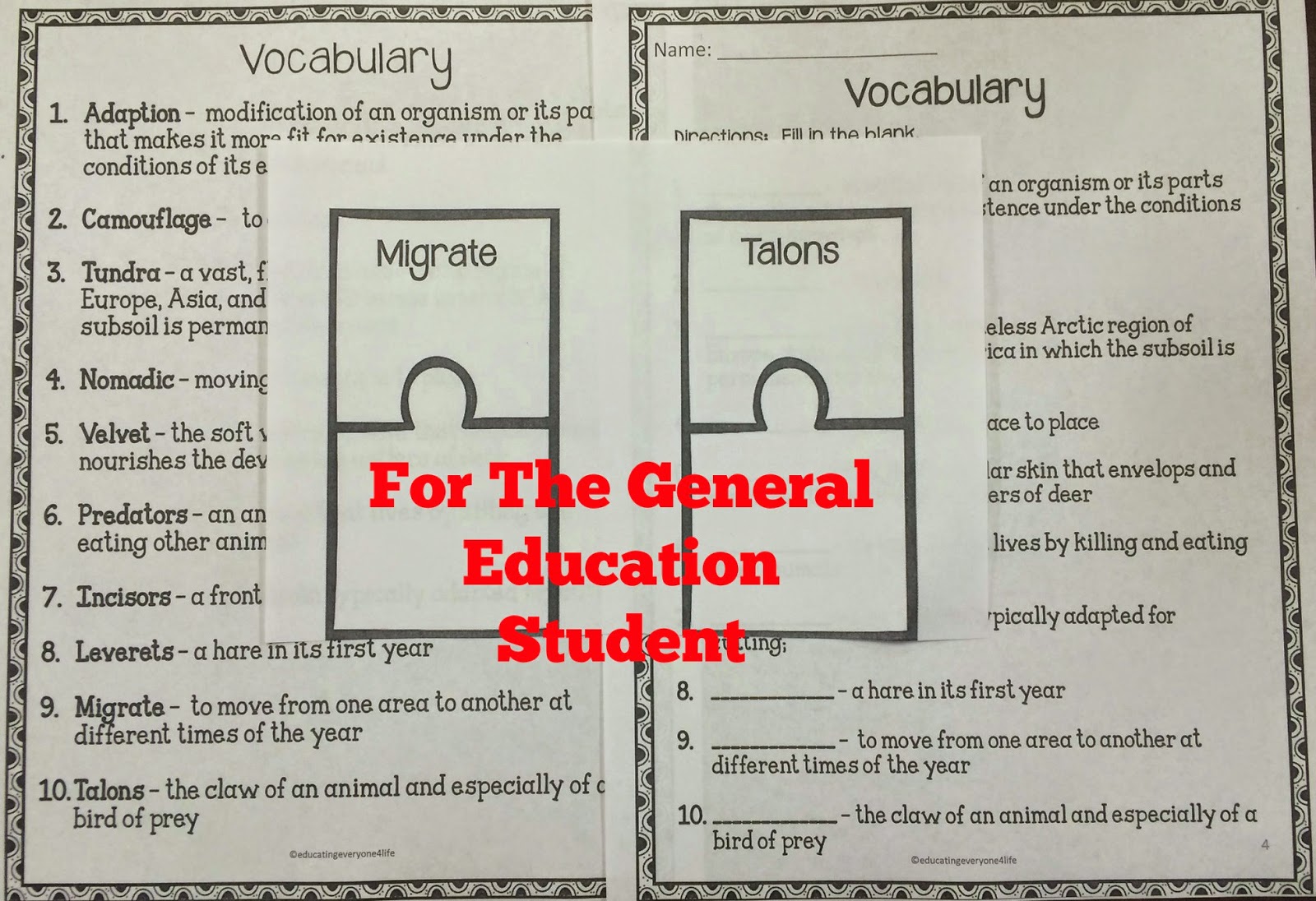
For the ESL learner or special education student, I may shorten or highlight the text, and depending on the needs of the students I would allow them to illustrate the word, or I would provide an illustration for the student.
The pictures below illustrates how I may modify for my students who are learning a new language or have communication disabilities:

Manipulatives and Hands-On Assignments
Provide students manipulatives and lessons that allow the students to draw, create, paint. Use a variety of sense of styles when teaching content and skills.
Create a Safe Environment
Children learn best when they feel safe and secure. Allow your students the opportunity to make mistakes. Let them see you make a mistake. I always call my students my classroom family. In my classroom family we take turns, share, learn, make mistakes, and help each other along our educational journey.
There are many ways to help foster communication in the classroom. These are just a few of the things I do daily to help my children become successful lifelong learners.


Friday, January 29, 2016
Multi-Step Word Problems

Multi-step word problems can be fun and challenging for children to solve. Word problems are problematic for children because they use both side of the brain. They use logical skills (numbers) and verbal language skills (words).
Deciding which operation to use can be a difficult task for children. In multi-step word problems,
there may be more than one operation students need to use in order to solve the problem.
Word problems describe a life
situation. This can make it complicated for children to understand the question the word problem is asking.
Before solving the problem, it is important to remind
students to slow down and clarify the question.
Asking students questions while they are
solving the problem is a helpful way of pointing out the information they will
need in order to solve the word problem correctly.
Examples Of Questions To Ask
Students:
What do you know about this problem?
What do you need to know in order to
solve the word problem?
What is the question asking?
Teacher Tip
Using a highlighter, ask the students to
highlight the important information in the word problem. Next, ask the students to highlight the clues
in the problem and write down the words that provide the clues for solving the problem.
Example:
Mike was reading a book that had
412 pages. On Monday night, he read 123
pages. On Tuesday night, he read 143
pages. How many pages in the book does
Mike have left to read?
What is the question asking? How many pages are left to read.
How many pages are in the book? 412 pages
How many pages did Mike read on Monday? 123 pages
How many pages did Mike read on Tuesday? 143 pages

Sunday, October 11, 2015
Social Skills
TEACHING SOCIAL SKILLS
Social skills play
an important role in determining a child’s
future success in education.
Children who have good social skills learn how to act and react
in certain situations. Social skills enable children to know what is
expected of them in diverse settings, how to make good choices, and how to
treat others in an appropriate manner. Children develop their social
skills from interactions with others and everyday life situations, but it is
important that as educators we teach and reinforce our student’s social skills.
The Results for children who have been taught and who have learned appropriate
social skills can have a positive impact on life. For example, children
who have learned appropriate social skills from their parents and teachers are
more likely to earn a high school and college degree. They are more
likely to have a full time job. The research conducted by Pennsylvania
State University, has proven that social skills can impact the likelihood of a
child living in public housing as an adult or if they will be in a detention
center or arrested as adults. As teachers, it is critical we help our children
become productive individuals as an adult. We can start teaching our
children positive behavioral skills at a very early age.
It is helpful as an educator to
understand the types of social skills we should teach in the classroom.
We can classify the types of social skills to teach into three basic groups.
Survival skills – Survival skills include listening skills,
ignoring distractions, speaking nicely, or positive self talk.
Interpersonal skills- Interpersonal skills include getting along with others, playing with others, sharing, participating in activities, and taking turns.
Problem Solving skills (Conflict Resolution)-
Problem solving skills include apologizing, accepting the consequence
of an action, making good choices, and asking others for help.
One tool I use for teaching social skills is a Social Skills Interactive Notebook.

The students create a personalized notebook using the social skills that the child needs to learn.
Here are some examples the notebooks we create in my classroom:


https://www.teacherspayteachers.com/Product/Interactive-Notebook-Social-Skills-1761069
Monday, September 14, 2015
New York, New York!
The Teachers Pay Teachers contest is up and running! If you get a chance help this teacher's dream come true by winning a trip to New York City. Just click on the link and enter your email address and submit your vote! Thank you for your support!
http://wshe.es/gaagTw2M
http://wshe.es/gaagTw2M
Subscribe to:
Posts (Atom)