Disclosure

Sunday, August 7, 2016

Classroom Jobs

CLASSROOM JOBS


Be Sure To Click Below To View Additional Classroom Ideas and Products!

BACK TO SCHOOL LANGUAGE ARTS

Are you looking for fun and engaging language arts activities to use during the beginning of the school year? 

This activity book is aligned with The Common Core Standards and provides "no-prep" printable to get your class on the right track!


For additional back to school resources be sure and stop by my Teachers Pay Store!


Thursday, August 4, 2016

Tuesday, August 2, 2016

Develop Literacy Skills With Reading Write-Ups

Are you looking for reading activities to help your students develop their reading comprehension skills? Reading Write-Ups are a great way to help students develop and improve their literacy skills!


Click Here To Download These Reading Write - Ups


I love to laminate the pages in this resource, and I let my students use dry erase markers during their reading time and during our literacy station rotations.

Visit Me At: Educating Everyone  For More Ideas and Freebies!


Monday, February 1, 2016

Communicating In The Classroom


The world is becoming more multilingual  and miscommunication can be avoided if we begin to break down the language barriers.  


Communication is the key to success in the classroom.   For most children, communicating with their families, classmates, and teachers is an easy process.  However, communication may be difficult and challenging for children who are learning a new language or for children who have learning disabilities.  

Reasons Children And Adults Need To Communicate
  • To learn
  • To satisfy a need
  • To express thoughts and attitudes
  • To form relationships
  • To develop social skills


Through my experience as an ESL teacher, and a special education teacher I have learned through trial and error several effective strategies to use with students who need extra support understanding verbal and non-verbal communication.

Cultural Awareness

Teachers must understand Cultural Awareness and learn about different cultures.  Encourage all cultures to share and celebrate their similarities and differences.

As a classroom teacher communicating with families who speak a different language can be a challenge.  It is important to help multicultural families unite and work together.  When teachers and the community work together children are more successful in the classroom.


Children need academic content in both their native language and the language they are learning.  


As a classroom teacher, I know that it can be frustrating to try to communicate with a parent who does not speak your language.  


Empathize and Keep A Close Eye On Unspoken cues from the student.

Teachers can assign a buddy or another students who speaks the same language as the second language learner to help the student transition and feel safe.

Use Visual and Pictorial Representations

Using pictures to teach can help children understand what the teacher is communicating. Teachers can use pictures for social situations and academic skills.

When teaching students vocabulary words I allow them to view pictures of the term. Giving students the opportunity to illustrate the word will also help them make a meaningful connection.  I modify my instruction to meet the needs of the learner.

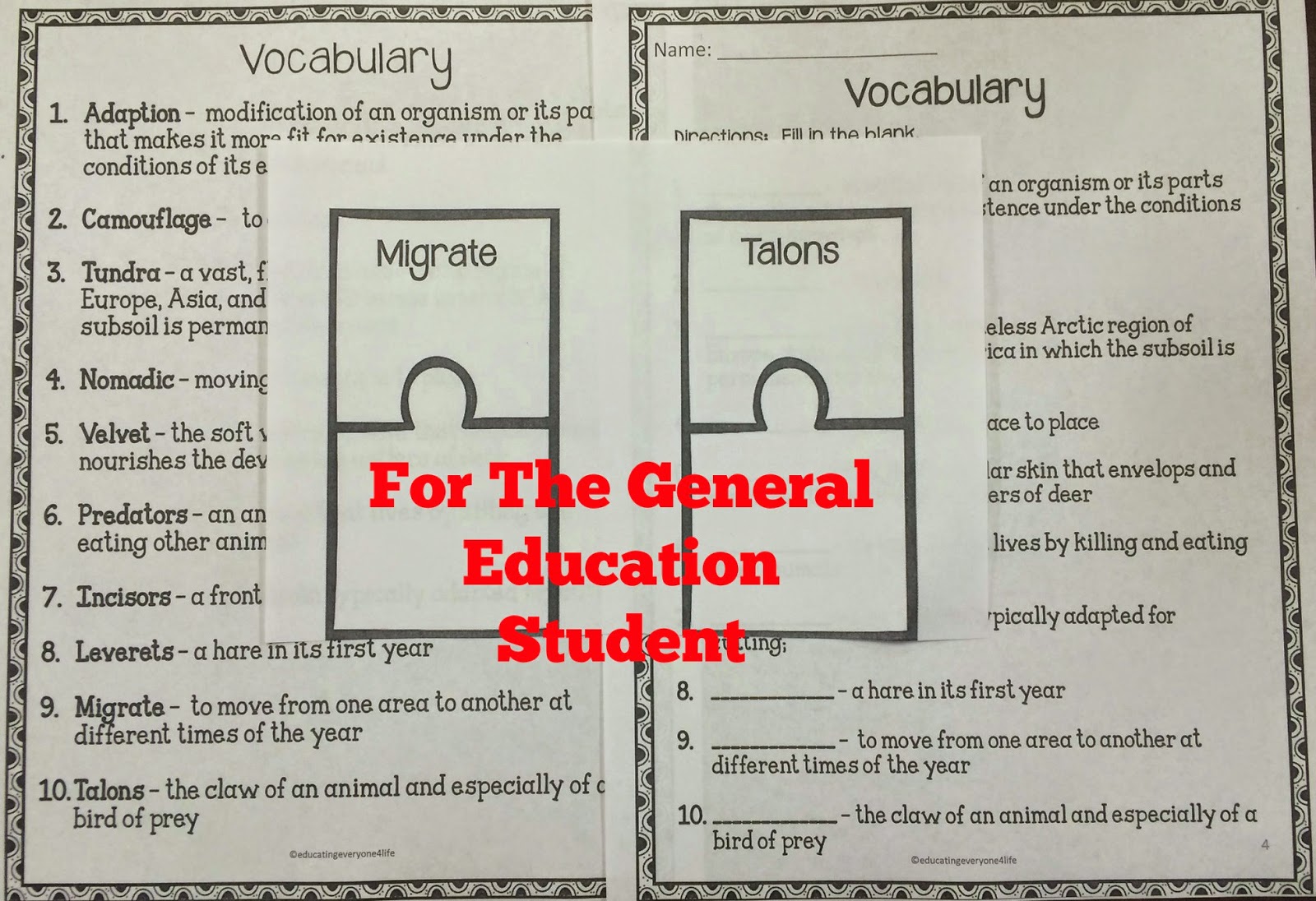
For the general education student, I may use the following lesson:


For the ESL learner or special education student, I may shorten or highlight the text, and depending on the needs of the students I would allow them to illustrate the word, or I would provide an illustration for the student.

The pictures below illustrates how I may modify for my students who are learning a new language or have communication disabilities:

Manipulatives and Hands-On Assignments

Provide students manipulatives and lessons that allow the students to draw, create, paint.  Use a variety of sense of styles when teaching content and skills.

Create a Safe Environment

Children learn best when they feel safe and secure.  Allow your students the opportunity to make mistakes.  Let them see you make a mistake.  I always call my students my classroom family.  In my classroom family we take turns, share, learn, make mistakes, and help each other along our educational journey.   

There are many ways to help foster communication in the classroom.  These are just a few of the things I do daily to help my children become successful lifelong learners.  


Friday, January 29, 2016

Multi-Step Word Problems


Multi-step word problems can be fun and challenging for children to solve.  Word problems are problematic for children because they use both side of the brain.  They use logical skills (numbers) and verbal language skills (words).

Deciding which operation to use can be a difficult task for children. In multi-step word problems, there may be more than one operation students need to use in order to solve the problem. 

Word problems describe a life situation. This can make it complicated for children to understand the question the word problem is asking. 

Before solving the problem, it is important to remind students to slow down and clarify the question.

Asking students questions while they are solving the problem is a helpful way of pointing out the information they will need in order to solve the word problem correctly.

Examples Of Questions To Ask Students:

What do you know about this problem?
What do you need to know in order to solve the word problem?
What is the question asking?

Teacher Tip


Using a highlighter, ask the students to highlight the important information in the word problem.  Next, ask the students to highlight the clues in the problem and write down the words that provide the clues for solving the problem.

Example:
Mike was reading a book that had 412 pages.  On Monday night, he read 123 pages.  On Tuesday night, he read 143 pages.  How many pages in the book does Mike have left to read?

What is the question asking? How many pages are left to read.
How many pages are in the book? 412 pages
How many pages did Mike read on Monday? 123 pages
How many pages did Mike read on Tuesday? 143 pages


Sunday, October 11, 2015

Social Skills

TEACHING SOCIAL SKILLS 

Social skills play an important role in determining a child’s future success in education.  

Children who have good social skills learn how to act and react in certain situations.  Social skills enable children to know what is expected of them in diverse settings, how to make good choices, and how to treat others in an appropriate manner.  Children develop their social skills from interactions with others and everyday life situations, but it is important that as educators we teach and reinforce our student’s social skills. The Results for children who have been taught and who have learned appropriate social skills can have a positive impact on life.  For example, children who have learned appropriate social skills from their parents and teachers are more likely to earn a high school and college degree.  They are more likely to have a full time job.  The research conducted by Pennsylvania State University, has proven that social skills can impact the likelihood of a child living in public housing as an adult or if they will be in a detention center or arrested as adults. As teachers, it is critical we help our children become productive individuals as an adult.  We can start teaching our children positive behavioral skills at a very early age. 

It is helpful as an educator to understand the types of social skills we should teach in the classroom.  We can classify the types of social skills to teach into three basic groups.


Survival skills – Survival skills include listening skills, ignoring distractions, speaking nicely, or positive self talk.

Interpersonal skills- Interpersonal skills include getting along with others, playing with others, sharing, participating in activities, and taking turns.            

Problem Solving skills (Conflict Resolution)-
 

Problem solving skills include apologizing, accepting the consequence of an action, making good choices, and asking others for help.

One tool I use for teaching social skills is a Social Skills Interactive Notebook.  

The students create a personalized notebook using the social skills that the child needs to learn. 

Here are some examples the notebooks we create in my classroom:


If you would like to download a copy of my social skills notebook to use with your students click on the link below:

https://www.teacherspayteachers.com/Product/Interactive-Notebook-Social-Skills-1761069


Monday, September 14, 2015

New York, New York!

The Teachers Pay Teachers contest is up and running! If you get a chance help this teacher's dream come true by winning a trip to New York City.  Just click on the link and enter your email address and submit your vote! Thank you for your support!

http://wshe.es/gaagTw2M


Wednesday, August 19, 2015

Back To School Tips For The Special Education Classroom

Special Education Back To School Tips

It's that time of year again! Transitioning from the relaxing summertime freedom to the busy school year can be stressful.  I have put together a few tips and tricks that I use in my classroom, and I want to share them with you.  I wish you all a wonderful school year!

 Review and Understand Your Student's Individualized Education Plan


The IEP is the essential element in the special education classroom.  When reviewing your the IEP's for your students:


  • Make sure the IEP is current
  • Check for accuracy
  • Look for special needs that may be important in order for the child to be successful.
  • Understand accommodations and modifications
  • Take note of important meeting dates
  • Review your students level of performance 
Establish Rules

I am a fan of Fred Jones and his classroom management techniques.  Through experience I have found that having a few rules in the classroom is really all you need.  In my classroom, I have two rules.

1.  Be Responsible - This rule includes things like:  completing assignments, cleaning up work area, having supplies ready for class, etc.

For example, if I have a child who did not complete his assignments, I can ask him, "Are you being responsible?"

2.  Be Respectful - This rule includes thinks like:  How you treat others, how you treat yourself, how you treat adults etc.

For example, if I have a student who is not sharing, I can ask him,"Are you being respectful?"

Believe it or not, this has worked for me throughout my many years of teaching.


Establish Routines

I spend the first week or two of school focusing on my classroom expectations and routines.  I have routines for everything.  The students know what to do the minute they walk into my classroom.


I have a work-box waiting on them in the same spot everyday.  They walk over to the shelf, grab their box, and begin working on their assignment.  This allows me time to take care of anything that I may need to handle before I start focusing on my daily objective.  It also keeps the students focused and on task.  Therefore, behavior issues rarely occur.

Another routine I use in my classroom is an attention grabber.  If I am ready to teach a lesson and the children are working independently, on the computer, or in a center, I simply state, "Hands on shoulders, eyes on me."


As simple and silly as this may sound, you have the children's attention immediately and they are not fidgeting and playing.  They are listening.  It works.  I promise.


Communication

Communication is so important as a special education teacher.  It is important to communicate with parents to understand their expectations for the school year.


One way I communicate with parents at the first of every school year is by using parent surveys.  I send a survey home with the student.  It is important to know and understand the parent's view of the child.  We are teaching the thing that is most important in their life.  If we take time to build positive relationships with parents it really does help the child.


Communication with the general education teacher is also critical.  It is important that the general education teachers and special education teachers work together.  We quickly learn in our line of work that we have to be flexible and understanding.  It really does take a team to make each child successful.

Communication with students is also very important.  Children need to clear understanding of the teacher's expectations.

Provide Students Choices

In my classroom, I allow students to have choices.  I have a reward system called "Activity of Choice."  When a student completes an assignment or has earned a positive incentive I allow them to choose an activity.  They can choose to get on the computer, play an educational game, read a book, etc.  This is a FREE reward system that students will work very hard to earn.


I hope these tips and tricks will help you this year!  I admire each and everyone of you for the job you do!   


Sunday, July 26, 2015

Classroom Rules


Are you looking for ways to help create a positive learning environment in your classroom? 

Clearly defined expectations are a critical component to a successful classrooms.  When children understand the expectations of the classroom, they will be more engaged with academic task.  Student achievement will continue to flourish inside your classroom when they are provided with consistent rules and expectations. 

During the first week of school we practice, practice, practice the rules and expectations.  

We read our "I can expectations" together.


I model rules and then we role play the rules!

We also create a book all about the rules.  When a student needs a friendly reminder about a specific classroom rule, we reread our rule books together.  


Teaching the children the rules and expectations at the beginning of the year helps to keep our classroom engaged and focused on academic achievement!

Click here to view these Classroom Rules in my Teachers Pay Teachers Store:
https://www.teacherspayteachers.com/Store/Educating-Everyone-4-Life

Thursday, February 19, 2015

FREE SOCIAL STORY - Blurting Out


Do you have students who need help learning the classroom rules? I have created a social story for the children in my classroom who need extra practice.  I would love to share this social story with you.  


Just click on the link below the picture to download this "Blurting Out" Freebie!


Click here to download this FREE Social Story:


Sunday, January 11, 2015

Thank You Teachers Pay Teachers and TBOTEMC


Thank You Teachers Pay Teachers and TBOTEMC For Helping To Make My Dreams Come True!

If you are a seller on Teachers Pay Teachers and you are looking to move next level I recommend joining!


http://www.teacherspayteachers.com/Product/The-Best-of-Teacher-Entrepreneurs-Marketing-Cooperative-1054613

Teachers Pay Teachers and TBOTEMC has changed my life forever!

Click here to visit my Teachers Pay Teachers Store!

Friday, January 9, 2015

Arctic Animals

Arctic Animals 


This week in my classroom we have been learning about the animals that live in the Arctic. To begin the Arctic unit, I introduced the vocabulary.  The kids had a blast making their vocabulary puzzles, and they were able to play a matching game with a partner.  


Next, we completed our KWL chart:


The the kids did a pair share with the reading comprehension passage:


 Here is our graphic organizer we completed after they had read the passage:


For each of the Arctic animals we studied the kids completed an assessment.  


My class really enjoyed learning about the Arctic!!!

Here is one of the activities we did after we had read about the Arctic Hare.   We folded a piece of copy paper, the student created an illustration of the animal we learned about, and then the student wrote three facts about the animal.


Thursday, January 8, 2015

The Elvis Approach To Classroom Management

The Elvis Approach To Classroom Management


Through research and personal experience I have learned that classroom management is the most important factor in determining the academic success of students.  Effective teachers understand the importance of building relationships with their students.  The teachers actions in a classroom have twice the impact on student achievement as do school policies regarding curriculum, assessments, and community involvement (Marzano, 2003).

I decided to write my classroom management tips and tricks with the help of Elvis.


Students cannot learn in a chaotic classroom that lack procedures, routines, and expectations.  Effective teachers plan and prepare for the success of their students. Teachers should have an assignment ready when the students walk through the door.  Idle time in the classroom leads to behavior problems.  I have learned through experience, that having a routine provides clear expectations.  I teach language arts.  Every morning before my students enter the classroom, their journal, assignment, and pencil has been placed on their desk.


My students know what to expect from the minute they walk into my classroom. I teach and model this daily starting the first day of school.  It doesn't take the children long to learn the classroom expectations. Within 2-3 weeks, my students (all of them) come in quietly and start their daily routine.  Many students lack structure and routine in their home environment.  They do not know what to expect next.  In my classroom, my students clearly understand the expectations of the classroom.  In 17 years teaching, I can count the number of office referrals I have written on my hands.

Lack of routines and procedures lead to chaos.

Prepare Routines and procedures for the following:

  • Arrival to class
  • Transitions (hallway, switching classes, etc.)
  • Answering question
  • Lunch count
  • Daily routines
  • Quiet time
Procedures must be stated, explained, demonstrated, and practice in the classroom.


Make learning meaningful and important to the students.  Let's face the truth, while each of us may teach a particular grade or subject matter, that does not mean all children are coming to us on the same instructional level.  We know that there are different learning styles, and as a teacher it is our responsibility to meet the needs of each and every student that walks through our door.  This can be an overwhelming responsibility for the instructional leader.

Children will want to learn if you Shake, Rattle, and Roll and do things different than the traditional classroom.

Here are a few things we do in my classroom to help keep children motivated and excited about learning:


Children need to explore and engage in activities and lessons that are beneficial for their development.  Expecting children to conform to a standardized list of expectations is not realistic.  As teachers we want to help our students learn positive behaviors.  It is important for teachers to focus on positive behaviors.  It is important for teachers to monitor behavior and practice skills that minimize classroom disruptions.  Eye contact, proximity, and body language are free tools teachers can use to promote the desired behaviors.


Tuesday, January 6, 2015

Communication In The Classroom


The world is becoming more multilingual  and miscommunications can be avoided if we begin to break down the language barriers.  

Communication is the key to success in the classroom.   For most children, communicating with their families, classmates, and teachers is an easy process.  However, communication may be difficult and challenging for children who are learning a new language or for children who have learning disabilities.  

Reasons Children And Adults Need To Communicate
  • To learn
  • To satisfy a need
  • To express thoughts and attitudes
  • To form relationships
  • To develop social skills

Through my experience as an ESL teacher, and a special education teacher I have learned through trial and error several effective strategies to use with students who need extra support understanding verbal and non-verbal communication.

Cultural Awareness

Teachers must understand Cultural Awareness and learn about different cultures.  Encourage all cultures to share and celebrate their similarities and differences.

As a classroom teacher communicating with families who speak a different language can be a challenge.  It is important to help multicultural families unite and work together.  When teachers and the community work together children are more successful in the classroom.

Children need academic content in both their native language and the language they are learning.  

As a classroom teacher, I know that it can be frustrating to try to communicate with a parent who does not speak your language.  


Empathize and Keep A Close Eye On Unspoken cues from the student.

Teachers can assign a buddy or another students who speaks the same language as the second language learner to help the student transition and feel safe.

Use Visual and Pictorial Representations

Using pictures to teach can help children understand what the teacher is communicating. Teachers can use pictures for social situations and academic skills.

When teaching students vocabulary words I allow them to view pictures of the term. Giving students the opportunity to illustrate the word will also help them make a meaningful connection.  I modify my instruction to meet the needs of the learner.

For the general education student, I may use the following lesson:


For the ESL learner or special education student, I may shorten or highlight the text, and depending on the needs of the students I would allow them to illustrate the word, or I would provide an illustration for the student.

The pictures below illustrates how I may modify for my students who are learning a new language or have communication disabilities:


Manipulatives and Hands-On Assignments

Provide students manipulatives and lessons that allow the students to draw, create, paint.  Use a variety of sense of styles when teaching content and skills.

Create a Safe Environment

Children learn best when they feel safe and secure.  Allow your students the opportunity to make mistakes.  Let them see you make a mistake.  I always call my students my classroom family.  In my classroom family we take turns, share, learn, make mistakes, and help each other along our educational journey.   

There are many ways to help foster communication in the classroom.  These are just a few of the things I do daily to help my children become successful lifelong learners.